Connecticut shellfish have never been associated with a Vibrio vulnificus outbreak. Vibrio vulnificus does cause wound infections in Long Island Sound.
Vibrio vulnificus can cause infections from consumption of raw or undercooked seafood; however, no Connecticut shellfish have ever been associated with Vibrio vulnificus illnesses. Nationally, there are approximately 150-200 Vibrio vulnificus infections reported to the CDC each year, of which only 10% are associated with shellfish consumption (CDC, 2023). The remaining 90% of cases are caused by open-wound contact with salt or brackish water (CDC, 2023).
Vibrio vulnificus naturally occurs in Long Island Sound, and can cause wound infections that can lead to limb amputation and sepsis in severe cases. In 2020, there were 5 confirmed Vibrio vulnificus wound infections, while there were only 7 total cases from 2010-2019 (Connecticut Department of Public Health). To minimize the risk of Vibrio vulnificus wound infections, the Department of Public Health recommends staying out of salt and brackish water when wounds are present, or cover wounds with a waterproof bandage if avoidance is not possible. Protective gloves can be worn when crabbing, fishing, and shellfishing. If a wound is sustained, wash the area thoroughly with soap and water. The Bureau of Aquaculture has prepared a Guidance Document for Recreational Shellfish Harvesting and Vibrio, and maintains a webpage on shellfish safety and handling.
In 2023, there were 2 Vibrio vulnificus wound infections in Connecticut, and 3 Vibrio vulnificus deaths in CT and NY in 2023. No Vibrio vulnificus illnesses have been reported from Connecticut shellfish, and the Bureau of Aquaculture routinely monitors for Vibrio vulnificus and Vibrio parahaemolyticus levels in commercial oysters statewide. The Bureau of Aquaculture did not detect Vibrio vulnificus in commercial oysters in 2022 or 2023. In 2023, one Connecticut resident contracted Vibrio vulnificus from consuming shellfish from outside of Long Island Sound (i.e. not CT or NY shellfish); however, as previously demonstrated, Vibrio vulnificus cases from shellfish consumption are very rare (only 15-20/year).
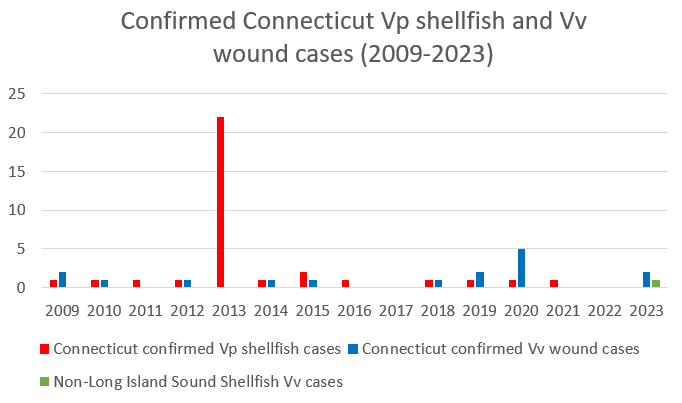
Confirmed Vibrio parahaemolyticus shellfish consumption cases (Bureau of Aquaculture) and confirmed Vibrio vulnificus wound cases (Department of Public Health) in Connecticut from 2009-2025. In 2023, there was one case of a Connecticut resident that contracted Vibrio vulnificus from consuming shellfish from outside of Long Island Sound. No Long Island Sound (CT and NY) shellfish have been implicated in a Vibrio vulnificus illness. In 2024, there was one confirmed Vibrio illness from CT shellfish, but the species could not be identified by the lab.


